Through a small-scale media ethnography, this essay examines how Polish language use, media objects, and social interactions intersect with Austrian norms and neighborhood life. By focusing on mundane practices and encounters, the essay highlights how diversity, conviviality, and media pluralism are lived and negotiated on a micro level in contemporary Vienna. It was written for a diversity course.
1. Introduction
In Vienna’s urban life, small ethnic grocery stores have become key spaces where migration, language and media intersect in mundane and meaningful ways (Valcke et al., 2015; Duru & Trenz, 2017). Vienna is one of Europe’s big immigration cities, and the Polish grocery store is more than just a place to buy familiar products, but also a social and communicative hub where Polish language, cultural memory, and everyday routines are sustained and renegotiated (City of Vienna, 2025a). For many customers, entering the store means also entering a space where accents, jokes and media from home coexist with Austrian rules, prices and everyday neighborhood life, which brings together broader questions about how diversity is organized and lived in contemporary Austria (Athique, 2016; Valcke et al., 2015; Seethaler & Beaufort, 2024).
This essay examines one Polish grocery store in Vienna as a diasporic place of belonging, with the focus on how language use, interactions and media objects shape the experiences of community and difference. Based on a small-scale media ethnography, it understands the store as a micro-arena where Polish is seen, heard and felt through talk, packaging, newspapers, posters and social media, and where these resources continuously negotiated in relation to the German language and institutional norms (Hammersley & Atkinson, 2019; Metykova, 2016). Instead of seeing the store as a marginal curiosity, the analysis shows how everyday spaces can shed light on wider debates about media diversity, conviviality and multiculturalism in Vienna.
The essay is guided by two research questions. First, how is the Polish language used, displayed and heard in the Polish grocery store during everyday interactions and through media? Second, in what ways can conviviality, everyday multiculturalism and media diversity help understand how the Polish store operates as a diasporic place of belonging in Vienna? To address these questions, the essay draws on key concepts from media and communication studies and migration research: diversity, media pluralism, conviviality, multiculturalism, ethnic space and language maintenance (McQuail, 1992; Valcke et al., 2015; Duru & Trenz, 2017). Based on Athique’s notion of transnational audiences, it understands customers as audiences who move between Polish and Austrian media worlds and sees the store as a small part of the network that keeps those connections alive (Athique, 2016). The main argument is that the Polish grocery store acts as an everyday media hub and a space where customers can feel a sense of belonging. It shows how media diversity and everyday multicultural life can work on a small scale, but also where the diversity in Vienna/Austria and the ideas thereof fall short (Valcke et al., 2015; Duru & Trenz, 2017).
2. Context: Vienna and Migration
Vienna has been a city shaped by migration for a long time. About one third of its residents were born abroad, with large groups from former Yugoslavia, Turkey, Poland and more recently Syria and Afghanistan (City of Vienna, 2025a). The city officially sees this as “compacted diversity”, integrating policies focused on integration monitoring, language courses and anti-discrimination measures (City of Vienna, 2023). But still, debates about segregation, housing and cultural differences run strong, especially around newer migrants. Polish migrants fit into the mix as one of the bigger groups of the EU, often coming for work or family and settling in neighborhoods where ethnic shops already cluster, like Favoriten or Leopoldstadt.
Since Poland joined the EU in 2004, many Polish citizens have moved to other EU countries looking for work. A big number of these Poles live and work in Austria, especially in and around Vienna. Many of them work in construction, care or hospitality, and while some stay short-term, other build their whole lives in Vienna (City of Vienna, 2025a). Polish communities here are visible through churches, cultural clubs and shops, like the one I studied. These stores do not only sell food like pierogi (dumplings) or oscypek cheese, but also newspapers, event flyers, skincare products, cleaning supplies, and seasonal items for holidays like Wigilia (Christmas Eve). They are not only practical hubs, but also places where people bump into their neighbors, chat about news from Poland or exchange information about Austrian bureaucracy. The shop I focus on is in a diverse neighborhood in Vienna and is open from Monday to Saturday, attracting mainly Polish regulars but also some non-Polish customers.
Austria’s media system combines public service broadcasting with commercial pressures. The public broadcaster ORF is still very influential and widely trusted by audiences, although the newspaper and online market is still concentrated in a few owners (Seethaler & Beaufort, 2024). Even though press freedom is rated highly, minority perspectives are often underrepresented in mainstream media. There are migrant and ethnic media in languages such as Turkish or Bosnian, but these outlets are usually small, with limited funding, and mainly reach only their own communities. Polish migrants have access to some Poland-related media such as Polish-language weeklies or community pages on Facebook that cover local events from Poland. However, mainstream German-language media rarely pick up the everyday concerns of Polish people living in the city. In this media landscape, Polish grocery stores can be understood as informal media spaces. They offer Polish newspapers, display posters, and sometimes share information from social media. This helps migrants access news and information in their own language but also raises questions about media diversity. Do these spaces truly increase media pluralism, or do they mostly provide separate information for different groups? These questions are important in a city like Vienna, which officially promotes diversity and participation for all, yet where migrant media often remain marginal (City of Vienna, 2023).
Polish grocery stores are also important for how migrants keep their language and culture alive. Research on ethnic shops can show that they work as “tastes of home” that make it easier to settle in a new country and to build community (Parzer, 2016; Hua & Wei, 2017). In Vienna’s multi-ethnic neighborhoods, these stores are part of everyday life, next to places like Turkish kebab stands or Balkan bakeries, rather than separating them completely. At the same time, language differences still matter: German is the official language, so while Polish-language spaces can feel like a relief, they also show who can move easily between these languages and who cannot.
This broader context shapes my study. Vienna has tried to manage diversity through policies and monitoring, while Austria’s media system has strong points but also big blind spots when it comes to migrants. Polish shops sit in between these worlds as commercial places that also spread information and media. The store I focus on brings these issues together in one small setting, which gives a useful perspective for my questions about language, belonging and media diversity.
3. Theoretical Framework
Since this essay brings together several concepts that help make sense of how the Polish grocery store works as a diasporic space of belonging, it is important to first clarify what these concepts mean and how they are used in this essay. The concepts include diversity and multiculturalism, conviviality, media pluralism and media diversity, transnational audiences and ethnic space, and language maintenance. These concepts mainly stem from media and communication studies, but in this case, they are applied to an everyday setting.
3.1. Diversity, multiculturalism, and conviviality
Diversity is an important but often quite vague term in media and communication studies. McQuail describes diversity as one key dimension of media performance, which is linked to public interest: media should offer a wide range of content, voices and viewpoints, allowing different groups in society to see themselves reflected and access relevant information (McQuail, 1992). In policy debates in Europe, diversity and multiculturalism usually refer to recognizing different cultural, ethnic and linguistic groups within one society, and to the question of how these groups can live together on fair terms.
Duru and Trenz argue that the sole idea of diversity is not enough, they argue that we also need to look at how people actually live with difference in practice (Duru & Trenz, 2017). They use the concept of conviviality to describe everyday situations, where people with different backgrounds share spaces, routines and interactions. At the same time, they stress that this everyday ease does not remove deeper conflicts or inequalities. Conviviality can sit on top of structural problems, rather than solving them (Duru & Trenz, 2017).
3.2. Media pluralism and media diversity
While media pluralism and media diversity are closely related to diversity, they focus specifically on the media systems. McQuail connects media diversity to the quality of media performance, including diversity of supply (different outlets), diversity of content (topics and perspectives) and diversity of exposure (what do the audiences consume?) (McQuail, 1992).
Metykova shifts her focus on media diversity in relation to migration and minorities. Her idea suggests three key questions: who is represented, who has access to different media and languages, and who can participate in producing or shaping media content (Metykova, 2016). For migrants, media diversity is not just about the number of channels, but about whether they can find information and news in their own language, see their own experiences, and use media to connect across borders.
In this essay, the ideas are scaled down to the level of a Polish grocery store. The shop is not a media outlet in the classic sense, but it hosts and circulates media objects such as packaging, Polish newspapers, advertising, posters and social media posts. By looking at the availability of media, the store can be analyzed as a small media node that contributes to media pluralism and diversity for Polish-speaking people in Vienna (Valcke et al., 2015; Metykova, 2016; Seethaler & Beaufort, 2024).
3.3. Transnational audiences, ethnic space and language maintenance
Athique presents the concept of transnational audiences, which helps to connect media theory with everyday migrant life. He argues that nowadays many people consume media across borders and languages, and that their media use is connected to transnational social networks, memories and identities (Athique, 2016). Diasporic audiences often follow both media, the ones from their “home” and their “host” countries, so they mix content from different places in their everyday routines. In this essay, a Polish grocery store in Vienna is part of the city that makes such transnational media use possible, for example by selling Polish newspapers, playing Polish radio, or sharing information via social media.
To describe it in physical terms, the idea of ethnic space presents itself as useful. Ethnic shops can be understood as spaces where specific national or cultural identities are made visible and tangible through products, languages, decorations and social interactions (Hua & Wei, 2017). They create a sense of belonging, familiarity, and recognition for some customers, while also marking difference in the wider urban landscape. In this context, the Polish grocery store is understood as an ethnic space where Polish symbols, goods and language are highlighted, and where belonging is produced through everyday shopping and chatting (Hua & Wei, 2017).
Language maintenance is also a big part of this ethnic space. Spaces where Polish is spoken, read and heard help maintain the language across time and generations, especially in a city where German dominates the everyday public life. The store contributes to language maintenance through its packaging, signage, informal conversations and media, but it still must use German for some official information and when dealing with non-Polish customers. Looking at how these languages appear next to each other in the shop makes it easier to see how language maintenance and adaptation actually work in everyday practice in Vienna’s multilingual space (Pauwels, 2016).
3.4. Ethnography and media ethnography
Ethnography is a qualitative research approach that studies people in their everyday settings; this is achieved through participation, observation and detailed notetaking over a longer period Instead of only asking people about their opinion, ethnographers watch what people are doing, they listen to how they talk and try to understand how they make sense of their daily lives. Hammersley & Atkinson also emphasize that ethnography is reflexive. The researcher is part of a situation, and their presence and background can influence what they can see and how others respond to that difference (Hammersley & Atkinson, 2019).
In media ethnography, these ideas are applied to media-related practices. It looks at how media are intertwined in routines, spaces and objects, for example people using phones and public, how they talk about posts or how posters and newspapers appear in everyday places. In this case, media ethnography treats the Polish grocery store as a setting where media and communication are part of ordinary life. It notices which media are present, how people interact with them, and how this connects to language use and belonging. The short-term fieldwork in the store follows this approach by combining participant observation with an ethnographic diary and by using short scenes from the store to connect the theory to the concrete everyday practices (Hammersley & Atkinson, 2019).
4. Methodology
The essay is based on a small-scale media ethnography of a Polish grocery store in Vienna. Thus, it is not aiming to produce a fully representative study of all Polish shops or all Polish migrants in Austria, but to use one concrete setting to explore how language, media and diversity concepts play out in everyday life.
4.1. Research design
The fieldwork consisted of three visits to the same Polish grocery store over a limited period. The first visit had a strong focus on walking through the store, watching how people moved and interacted, and noting which languages were used in different situations. I paid particular attention to media objects in the space, such as the Polish kabaret (cabaret) poster at the entrance, Polish-language packaging on shelves, Polish newspapers near the counter and handwritten notes in the store. I also noted the overall atmosphere, including how people greeted each other, whether they chatted while shopping, and how the cashier interacted with people. On the second visit, I repeated this form of participant observation to see whether the patterns observed during the first visit were stable. Again, Polish seemed to be the default language between staff and Polish-speaking customers, and conversation at the counter often went beyond simple transactions, with people chatting briefly about everyday matters. Additionally, the visual presence of Polish remained strong through packaging, newspapers and posters. I treated this visit to check for routine, rather than exception, this follows Hammersley and Atkinson’s emphasis on building up a sense of typicality in ethnographic work (Hammersley & Atkinson, 2019)
On the third visit, I wanted to complement the observation with short, informal conversations, managing to get two. First, I spoke with one of the Polish customers and asked them to describe the store and the experiences that come with it. They described how the store had helped them when they first left Poland and moved to Vienna, especially since they did not feel confident in German and were not able to find familiar products in the usual stores. In the beginning, they often came to the store to ask practical questions, buy familiar food and simply hear and speak Polish in public, which made the move feel less overwhelming. Today, they do most of their weekly grocery shopping in the usual chains that can be found in Austria, but they still visit the Polish store at least twice a month. They explained that they come back because they miss certain Polish products, because they like the atmosphere and the small talk, and because their child, who spent most of its life in Austria, can have regular contact with the Polish language and culture, not only with German in school and in everyday life.
After that, I talked briefly with a cashier. She explained that this job had been very important for her when she arrived in Austria and could not yet speak German fluently and confidently. By being able to work in the shop, she was able to have an income and a Polish-speaking work environment where she could communicate comfortably and slowly pick up more German from customers and the daily life, complementing it with German classes in the evenings. She said that she especially enjoys the social contacts in the store and the chance to meet other Poles, and that the store became even more important after her elderly mother moved to Vienna due to health issues. Having easy access to Polish food, newspapers and conversations makes everyday life feel more manageable and familiar for both, especially since the mother does not speak any German at all. I did not record these conversations out of respect and ethical reasons but wrote detailed fieldnotes straight in and after leaving the store, with a focus on how they described language use, belonging, work and media relating to the store.
Across all those encounters, I kept an ethnographic diary in which I kept descriptive notes on what people were doing and saying, how the space looked and sounded, and how I felt in the setting. Based on these notes I analyzed the space and connected them to the key concepts previously described.
4.2. Ethnography, reflexivity, ethics
Ethnography is suitable for this project because it allows giving attention to small and often overlooked details of everyday life, such as how people greet each other, how and when they switch languages, or how they interact with media objects in and around the store. Rather than only relying on interviews or surveys, it focuses on what customers do in the given context and how practices unfold over time. At the same time, ethnography requires reflexivity, it needs to be recognized that the researcher is part of the field and can influence what happens and what can be seen (Hammersley & Atkinson, 2019).
In this essay, reflexivity meant being aware of how my position as a young, Polish student shaped my observations and interactions. My fluent Polish made it easier to have full conversations with staff and customers, including understanding inside jokes and fast exchanges with the customers, which gave me more access to different layers of meaning that might have had stayed hidden from non-Polish speakers (Hammersley & Atkinson, 2019). At the same time, for other people I was someone that was taking notes and spending more time in the store than a typical customer may have, which could make some people curious or more aware of what they were doing and saying. Rather than pretending that I was “invisible”, I treated these reactions as part of the data, so I can reflect on how my presence might have encouraged certain kinds of stories, such as emphases on how important the store is, or subtle shifts in how people talked to me about language, media and belonging (Hammersley & Atkinson, 2019).
When it comes to ethics, I avoided collecting identifying details and keep the shop and the people I interacted with anonymous in this essay. I do not mention the exact street or name of the store and do not describe people in ways that could make them easily identifiable. The informal conversations were kept short and focused on everyday experiences, hence why I did not ask for sensitive information or to record the conversation, since it could also affect the data. Additionally, it has been made clear that the material would be used for a university assignment. While taking photographs, I focused on signs and product display, ensuring that people around the store are not visible or blurred out, so that the photos can be used for analytic purposes still. This way, the approach follows basic ethical principles for a small-scale ethnography with small adaptations to it being a student project (Hammersley & Atkinson, 2019).
4.3. Fieldwork turns into analysis
Being able to analyze the data involved moving back and forth between my fieldnotes and the theoretical framework. After completing the visits, I read through the ethnographic diary entries multiple times to identify recurring themes, such as the prominence of Polish in signs and talk, which media is circulating in the store, the atmosphere and feeling of familiarity compared to larger supermarkets, and the ways customers and staff talked about the store’s role in their personal lives (Hammersley & Atkinson, 2019). I then linked these themes to the previously outlined concepts.
For example, language maintenance and ethnic space was connected to the visible and audible presence of the Polish language in the store, while the stories of the customer and cashier were analyzed using the concept of transnational audiences and diasporic belonging (Athique, 2016) and the atmosphere and everyday interactions were related to conviviality and everyday multiculturalism (Duru & Trenz, 2017). Additionally, I interpreted the objects in the store connecting to media pluralism and media diversity debates (Valcke et al., 2015; Metykova, 2016).
5. Analysis
5.1. Polish language in the store
Polish is visible and audible in the store almost everywhere. On the shelves, most of the products are in Polish-language packaging, while the price labels only add a “EUR” sign to fit the local context (Figure 1). Therefore, Polish acts as the main visual language of everyday products, turning the store into a public, accessible Polish-language environment inside a German-speaking city which supports language maintenance through routine shopping.
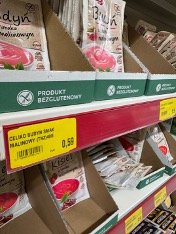
Figure 1: Packaging on the shelves
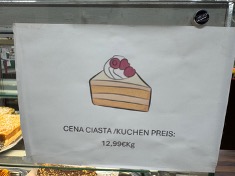
Figure 2: Cake prices
Multilingual signs show how different publics are addressed in the store. A notice at the meat counter announces delivery days in Polish, German, and Ukrainian (Figure 3). Another sign for cake prices uses Polish and German side by side: “CENA CIASTA/KUCHEN PREIS” (Figure 2). These examples show that Polish customers are the primary audience, while also considering German and Ukrainian speakers, which reflects Vienna’s changing migration patterns and the need to comply with regulations. In terms of language maintenance, the focus lies clearly on Polish, yet it coexists with other languages in practical ways rather than forming a monolingual micro-world.
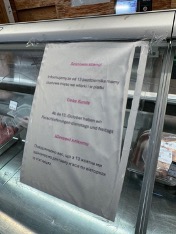
Figure 3: Notes in multiple languages
The spoken interactions follow a similar pattern. Fieldnotes show that staff and Polish-speaking customers normally talk in Polish about products and everyday life, switching to German mainly when addressing non-Polish customers or dealing with officials. This shows that language can be a flexible resource. While Polish signals familiarity and shared background inside the store, German still functions as the language of wider publics and institutions (Metykova, 2016). In practice, the store offers a stable setting where Polish is used, read and heard on the daily, supporting heritage language use beyond the private life.
5.2. Conviviality and everyday multiculturalism
The shop works as a convivial space. Across visits, the atmosphere felt familiar and warm, customers greeted the cashier by name, exchanged jokes and stayed at the counter after paying. One customer said the store had helped them in the first years in Vienna when they were hesitant about their German and did not know where to find all products. They now do most shopping in the usual stores but still visit the Polish store at least twice a month because they miss some products, enjoy the atmosphere and want their child, who mostly grows up using German, to still have contact with the Polish heritage.
These scenes fit Duru and Trenz’s idea of conviviality as living with difference in the everyday, based on the shared routines and a certain ease rather than talking about diversity constantly (Duru & Trenz, 2017). The store offers a place for Polish migrants to feel at home, build relationships and exchange information, which makes it more than just a retail environment. At the same time, conviviality is not equally available to everyone here. Non-Polish-speaking customers may feel that the shop is partly closed, because most interactions and information are in Polish. This also connects to Duru and Trenz’s warning that conviviality can coexist with inequalities and boundaries rather than overcoming them.
5.3. The store as a micro-media apex and multipluralism
The images from the store also show how it acts as a small media apex in Vienna’s media landscape. A large noticeboard and several posters advertise Polish cultural events, such as kabaret (cabaret) shows and the “Wielka Orkiestra Świątecznej Pomocy” (The Great Orchestra of Christmas Charity) charity event, alongside smaller advertisements for services like Polish-speaking doctors, language courses or smaller events (Figure 4). Another poster advertises a Polish kabaret performance in Vienna, with several details about tickets and the event (Figure 5).
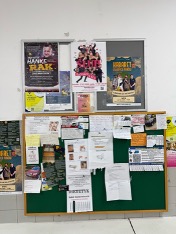
Figure 4: Noticeboard
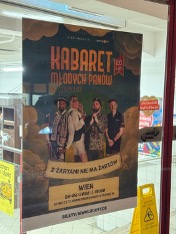
Figure 5: Kabaret poster
These materials demonstrate that the store is not only for selling products, but it also provides information and promotes Polish cultural life in Vienna.
From the perspective of media pluralism, this increases diversity at the levels of language and content. Polish-speaking customers can gather information about events, services and news that might not appear in daily Austrian media, which often do not represent minority perspectives enough (Valcke et al., 2025; Seethaler & Beaufort, 2024). Thus, the shop extends the accessibility of Polish-language media and community information into everyday spaces and therefore functions as an offline “feed” that works together with television, radio and online platforms. It also supports transnational audiences by keeping them connected to both contexts, Austrian and Polish, through a mix of imported media and local happenings (Athique, 2016).
Still, the media environment also shows limits of pluralism in the store. The posters represent certain types of actors, while other voices remain absent. Also, since the noticeboard is so crowded, it is not clear who controls it and how long the announcements stay up, which means that access to the noticeboard and the public may depend on personal connections to the resources themselves. Non-Polish, or non-fluent, speakers may look at the posters briefly while passing but cannot read them fully or at all, so the information remains gatekept within a specific group. Following Metykova, this suggests that media diversity is strong for fluent Polish-speakers but fragmented along linguistic boundaries and uneven in terms of participation and representation (Metykova, 2016).
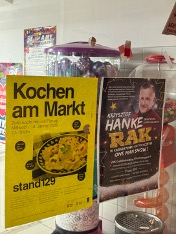
Figure 6: More posters
By pairing the German-language poster “Kochen am Markt – Zofia kocht mit uns Pierogi” (Cooking at the Market – Zofia cooks pierogi with us) with a Polish-language kabaret poster in the same corner, the visual scene becomes particularly interesting. It shows how Austrian and Polish cultural worlds overlap in this one space, the city-sponsored cooking event uses pierogi (dumplings) to promote diversity, placed next to the Polish-language comedy show aimed at local migrants. This combination highlights the tension between official narratives of diversity and the self-organized media spaces created by migrants. It supports the main argument that the Polish grocery store functions as an everyday media hub and ethnic space of belonging, showing small-scale media diversity and everyday multicultural living, while it also makes it visible where official ideas about diversity and participation in Vienna are still limited (Valcke et al., 2015; Duru & Trenz, 2017).
6. Conclusion
The essay explores how a Polish grocery store in Vienna works as a diasporic space of belonging by asking how Polish is used, displayed and heard in the store and how conviviality, everyday multiculturalism and media diversity help to understand the store’s role. The main argument has been that the store acts as an everyday media hub and ethnic space where Polish language and culture are maintained, while also exposing limits in how diversity and media pluralism are understood in Vienna and Austria.
The analysis showed that Polish is strongly visible and audible in the store through packaging, conversations and media, turning it into a microcosm where Polish can be used alongside German and even Ukrainian (Hua & Wei, 2017; Pauwels, 2016). This supports heritage language maintenance and illustrates how ethnic spaces can help migrants keep their culture alive in a city where German dominates everyday life, while it is still being shaped by regulations and mixed publics that require other languages as well (City of Vienna, 2025b; Metykova, 2016).
At the same time, the store functions as a convivial social setting where greetings, jokes and conversations make customers and staff feel at home, and where people can share advice, news and experiences about living abroad (Duru & Trenz, 2017). These scenes correspond with the ideas of conviviality and everyday multiculturalism, since they show how people live with difference in practice, but they also show that this ease is uneven, since non-Polish and non-fluent speakers may find parts of the space harder to access (Hua & Wei, 2017; Parzer, 2016).
Finally, the store acts as a small media apex in Vienna’s wider media landscape. Noticeboards, posters and newspapers bring Polish-language information into an ordinary store and help people move between Polish and Austrian media worlds (Athique, 2016; Valcke et al., 2015; Seethaler & Beaufort, 2024). At the same time, the strong focus on Polish-language media and the informal way the noticeboard is organized show current limits of media pluralism and participation, because they show how official ideas about diversity in Vienna often overlook these informal, small-scale infrastructures that are also important in migrants’ everyday lives (Metykova, 2016; City of Vienna, 2023; Hammersley & Atkinson, 2019).
Given the small-scale and short-term nature of the fieldwork, it is important to emphasize that the findings cannot speak for all Polish/ethnic stores or migrant groups in Vienna, but they highlight why such everyday spaces deserve more attention in future research.
References
Books and articles
- Athique, Adrian. (2016). Transnational audiences: Media reception on a global scale. Polity.
- Duru, Deniz, & Trenz, Hans‑Jörg. (2017). From diversity to conviviality: Intra‑EU mobility and internationalisation of public spheres. In Migration and media (pp. xx–xx). [Publisher].
- Hammersley, Martyn, & Atkinson, Paul. (2019). Ethnography: Principles in practice (4th ed.). Routledge.
- Hua, Zhu, & Wei, Li. (2017). Polish shop(ping) as translanguaging space. Journal of Intercultural Studies, 38(4), 381–398.
- McQuail, Denis. (1992). Media performance: Mass communication and the public interest. Sage.
- Metykova, Monika. (2016). Diversity and the media. Palgrave Macmillan.
- Parzer, Michael. (2016). Deliciously exotic? Immigrant grocery shops and their non‑migrant customers. European Urban and Regional Studies, 24(4), 420–435.
- Pauwels, Anne. (2016). Language maintenance and shift. Cambridge University Press.
- Valcke, Peggy, Sükösd, Miklós, & Picard, Robert G. (Eds.). (2015). Media pluralism and diversity: Concepts, risks and global trends. Palgrave Macmillan.
Web sources
- City of Vienna – Municipal Department 17 Integration and Diversity. (2023). Integration and diversity monitor 2023: Facts and figures on migration, integration and diversity in Vienna.
- URL: https://www.wien.gv.at/english/social/integration/facts-figures/monitoring.html [02.01.2026]
- City of Vienna – Municipal Department 17 Integration and Diversity. (2025a). Vienna’s population 2025: Facts and figures on migration – Viennese population. https://www.wien.gv.at/english/social/integration/facts-figures/population-migration.html [02.01.2026]
- City of Vienna – Municipal Department 17 Integration and Diversity. (2025b). Integration in Vienna: Multilingualism. https://www.wien.gv.at/english/social/integration/multilingualism/index.html [04.01.2026]
Leave a Reply